AI Literacy in Education: Turning a Global Framework Into Classroom Practice

- In June 2026 the OECD and the European Commission published a finalised AI Literacy Framework for primary and secondary education, organising the subject into four domains (engage with AI, create with AI, manage AI, shape AI) and 19 competences that blend knowledge, skills and attitudes.
- The framework arrives into a widening gap: surveys of nearly 50,000 students and faculty found adoption running well ahead of institutional guidance, with 72 per cent of students saying their assessments do not reflect the skills an AI-enabled workplace needs.
- A framework on paper is not practice. The recurring lesson across the reporting is that three things have to move together: teacher training, assessment redesign, and clear policy, none of which works alone.
- The evidence that structured AI use can help learning is real but early, and the strongest results still favoured stronger students, so equity has to be designed in rather than assumed.
- The thread running through every serious version of this debate is protecting human judgement. AI literacy is worth the effort only if it teaches people to use these tools honestly and to know when not to.
The gap the framework has to fill
The uncomfortable fact underneath most AI-in-education writing this year is a mismatch of speed. Students have adopted these tools faster than institutions have worked out how to guide them. Two large surveys of higher education, taking in nearly 50,000 students and faculty, described exactly this: adoption outpacing institutional capacity, students using AI without any structured training, and faculty in the United States and Canada quietly retreating, with the share intending to use AI in their teaching falling from 76 per cent to 67 per cent in a single year. The same reporting found that 72 per cent of students say their assessments fail to reflect the skills an AI-enabled workplace actually needs, and only 29 per cent believe their instructors are adequately prepared to guide them.
That is the problem a framework is meant to solve. Not by adding another tool, but by giving educators, policymakers and families a shared vocabulary for what “using AI well” even means. Writing in Forbes, the chief executive of Alef Education argued that national strategies have to shift from isolated pilot programmes to coordinated, systemwide reform, pointing to the UAE National Strategy for AI 2031 and the Australian Framework for Generative Artificial Intelligence in Schools as attempts to align high-level policy with classroom implementation. The barrier is rarely enthusiasm. It is coordination: the same piece noted that more than 40 per cent of educators cite insufficient technical support as a reason implementation stalls.
What the framework actually says
The most significant attempt to build that shared vocabulary landed on 18 June 2026, when the OECD and the European Commission published a finalised AI Literacy Framework for primary and secondary education, titled Empowering Learners for the Age of AI. It was not written in a room. The draft drew feedback from more than 2,000 people across over 100 countries, including teachers, school leaders, policymakers and researchers, before it was finalised.
The framework defines AI literacy as a combination of knowledge, skills and attitudes that let learners understand how AI systems work, critically evaluate their outputs, and use them ethically and creatively. It sets out 19 competences organised into four domains: engaging with AI, creating with AI, managing AI, and shaping AI. The domains are deliberately sequenced to mirror how a learner actually meets these systems, moving from awareness, to creative use, to responsible decision-making, to an understanding that AI is itself shaped by human values. Crucially, the competences fold in attitudes as well as technical skill: responsibility, reflection, curiosity, adaptability and empathy sit alongside the knowledge of how a model produces its answers.
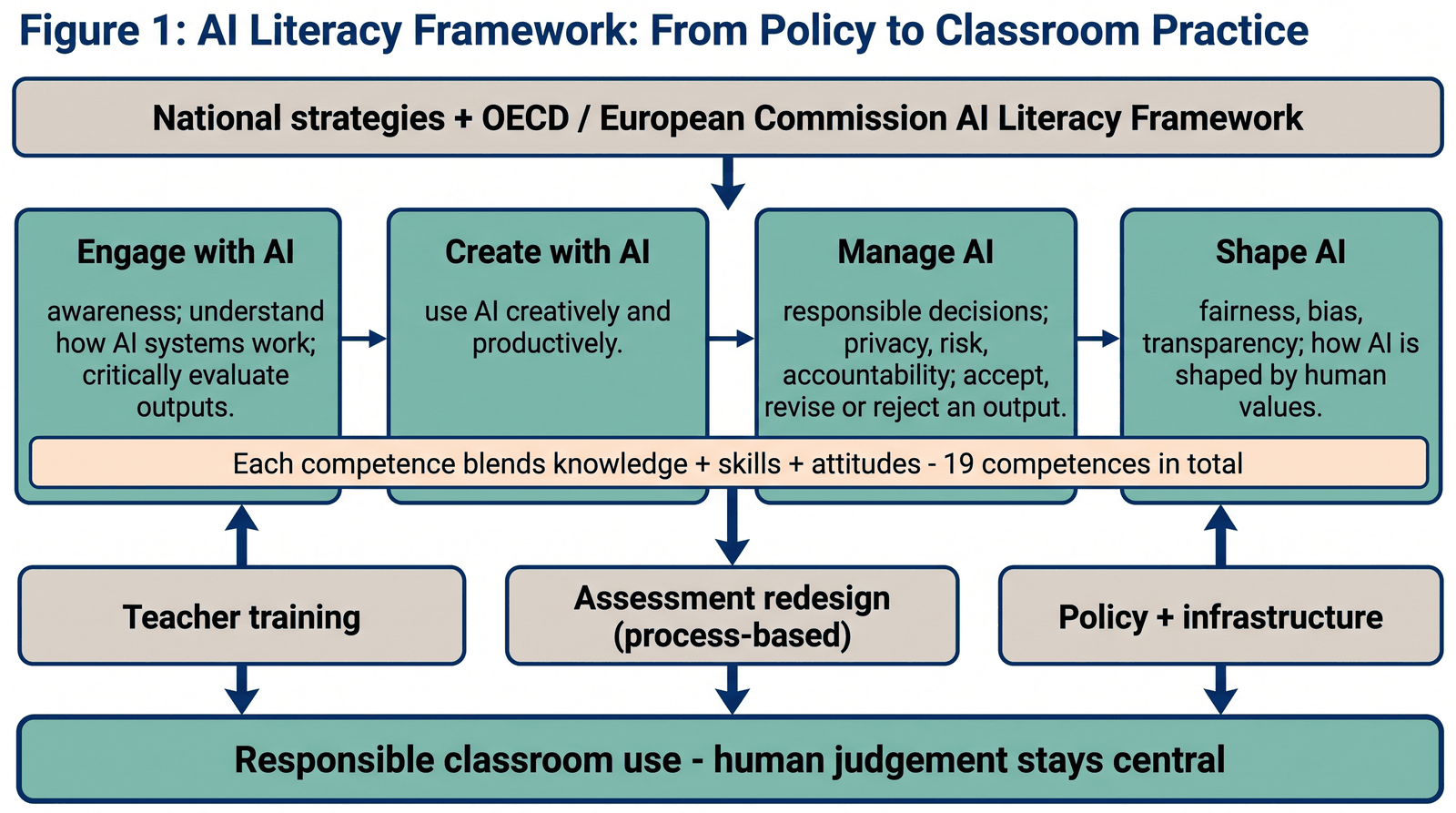
There is a detail in the framework that matters more than it first appears. Students are expected to learn to verify AI-generated information against trusted sources and to decide whether an output should be accepted, revised or rejected. That single competence is the whole argument in miniature. It treats the learner as the one holding judgement, with the model as something to be checked rather than trusted. The framework is non-binding, and it is careful to say so. Its next real test is scheduled for 2029, when the OECD folds media and AI literacy into its Programme for International Student Assessment.
From framework to classroom
A framework is a map, not a journey. The harder work is the three things that have to move together to turn it into practice, and the reporting this year keeps returning to the same three.
The first is teacher training, and here the demand is unambiguous. Microsoft’s AI in Education report found that training is the single form of support educators most want, with 87 per cent of educators and leaders, and 79 per cent of students, agreeing that knowing how to use AI responsibly matters for students’ futures. It is telling that Microsoft’s own educator credential pathway is grounded explicitly in the European Commission and OECD framework: even a commercial programme reaches for the shared standard. At a United States Senate subcommittee hearing, witnesses made the same case from the policy side, arguing that rapid development makes teacher training critical and that AI should be judged “by outcomes rather than hype”. One university described the scale required plainly: extending AI literacy across a whole curriculum meant hiring more than 100 new faculty with AI expertise, spread across its colleges rather than concentrated in the STEM departments, on the principle that AI education is a foundational requirement and not a specialist topic.
The second is assessment. If students can generate a passable essay in seconds, an assessment that rewards a passable essay is no longer measuring anything, and the line between human and machine prose is now genuinely hard to call, as we found when we tested it directly. The response is not detection software, which we have written about before and remain sceptical of. It is redesign. The University of Texas at Austin School of Law asked its faculty to lean back into Socratic, in-class dialogue, framing the shift around three questions: what AI knowledge students should learn, how to preserve the integrity of assessment, and how to keep the hard first-draft thinking with the student. The national-strategy analysis reached the same place from a different direction, calling for a transition toward process-based assessment that looks at how a student got to an answer, not only the answer itself.
The third is evidence, and this is where honesty is most important. There is a genuine, measured result worth taking seriously: a Google DeepMind study in Sierra Leone reported that an AI tutor, rebuilt from Gemini specifically to guide learning rather than hand over answers, helped students gain more than a year’s worth of schooling in eight weeks. That distinction, guiding rather than answering, is the same instinct as the framework’s “accept, revise or reject” competence. But the researchers were candid that stronger students benefited most, which is precisely the outcome that widens gaps rather than closing them. A tool that helps the already-confident pull further ahead is not a neutral good. Equity has to be built into the design, not hoped for after the fact.
Keeping the person in the loop
Run a thread through all of this and it comes back to the same knot: human judgement. The Senate hearing framed its whole case around AI “that protects human judgement in schools”. A commentator in The Korea Herald argued that the real question is not whether to ban these tools, which students already use outside school in any case, but whether education systems can integrate them without letting students drift from intellectual agency into dependency. The law school’s return to Socratic teaching is the same worry expressed as a timetable change.
This is the part of the debate that matters most to us, because it is the whole reason this office exists. Dr Lancaster’s work on academic integrity has always started from the same premise: the point of education is not the artefact a student hands in, it is the thinking that produced it. AI literacy, done properly, is not training in prompt-writing. It is training in when to reach for the tool, how to check what it gives back, and when to close the laptop and do the work yourself. The framework’s insistence that ethical judgement is “inseparable from learning with and about AI” is not a soft add-on. It is the load-bearing wall.
The same logic reaches beyond schools. UNESCO ran AI literacy training for more than 680 public-sector officials and researchers in Viet Nam this year, built around helping people understand AI as a tool that supports their work while recognising its limits and risks, with research integrity and accountability written into the programme. Different setting, identical principle. The skill being taught is not fluency with a chatbot. It is the discipline of staying accountable for the output.
What we take from it
The framework is a real step forward, and it deserves to be read rather than admired from a distance. A shared four-domain structure gives schools something to organise around, and it moves the conversation past the sterile ban-or-allow argument that dominated the first ChatGPT year. But nobody involved is pretending the document does the work. It is non-binding, its headline assessment is three years away, and the surveys make clear that the gap between student adoption and institutional readiness is still widening while the framework beds in.
So the honest position is neither dismissal nor celebration. The framework matters most as a common language for the three jobs that actually change outcomes: training the teachers, redesigning the assessment, and keeping human judgement at the centre of both. The technology has already arrived in the classroom, invited or not. What is still being decided is whether students come out of it more capable of thinking for themselves, or less. That decision is not made by a framework. It is made by every teacher, every assessment and every school that chooses to do the harder, slower version of this well.