OpenAI's data centre compact leaves partner sites outside its rules
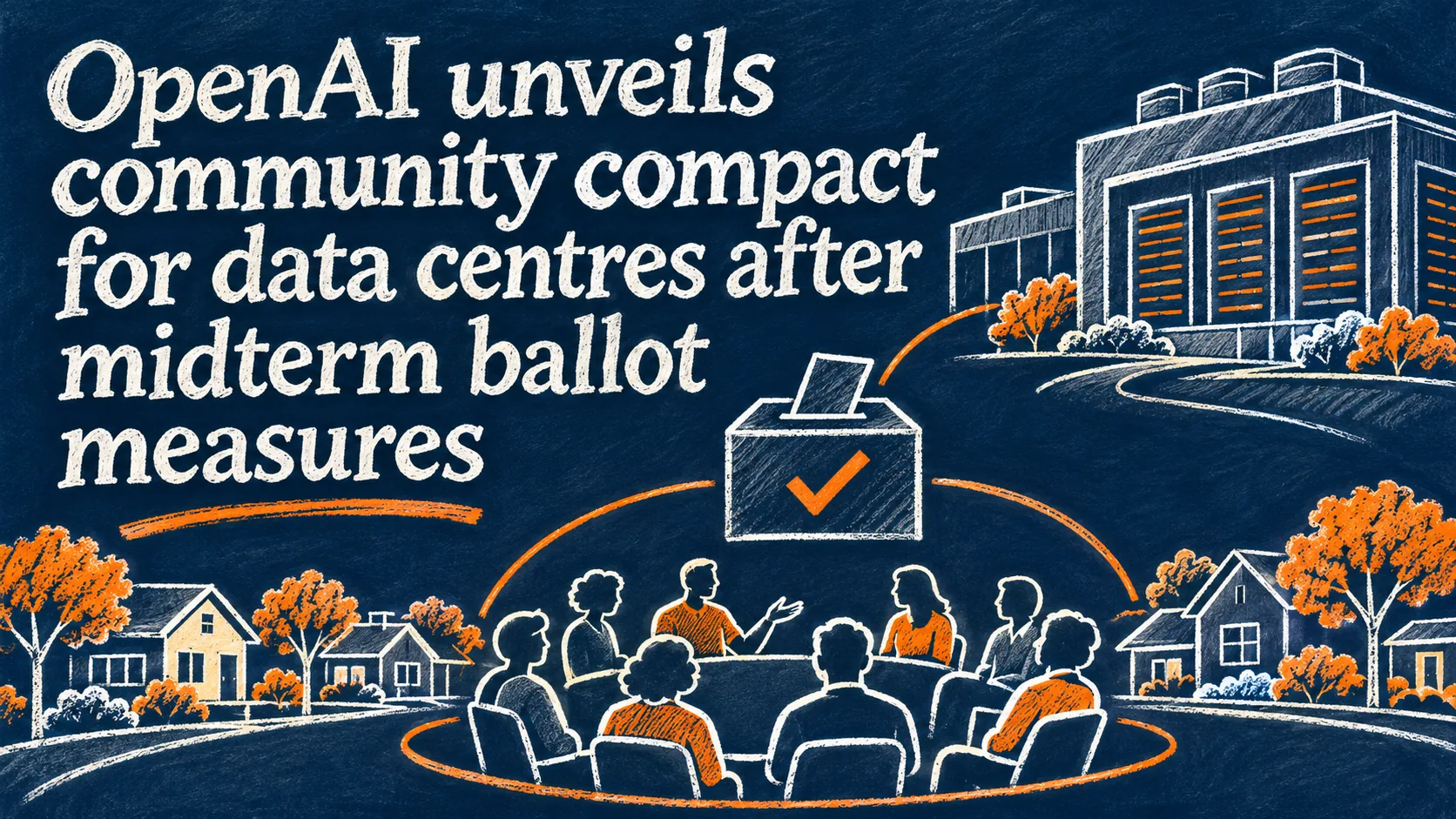
- OpenAI published a National Community Compact two days after voters in several US states backed ballot measures to curb AI data-centre construction.
- The compact covers only sites OpenAI owns and operates, while partners such as Oracle build and own much of its computing capacity.
- OpenAI pledged to pay full electricity and grid upgrade costs, publish per-site water and power use, and drop most non-disclosure agreements with public officials.
- A companion blueprint asks lawmakers to apply similar rules across the industry, including grid cost responsibility and public disclosure of tax incentives.
OpenAI has published a National Community Compact setting out how it will deal with the communities that host its data centres. It arrived two days after voters in several US states backed ballot measures aimed at restraining the artificial intelligence construction boom, as The New York Times’s report on the compact and the ballot measures sets out.
Each campus that OpenAI owns and operates would carry its own local agreement, and an annual public report. The company says it will pay the full cost of the electricity it uses, along with the grid upgrades that come with it. It will post financial guarantees, so households and businesses are not left paying for upgrades if a project is cancelled. It will publish water and power consumption for each site, and drop most non-disclosure agreements with public officials. It also promised $80 million of local investment in Effingham County, Georgia, and $40 million in Pike County, Ohio, where officials project roughly $66 million a year in payments once the site is fully built.
The gap between owned and partner sites
The pledges reach only as far as the sites OpenAI owns directly. Much of its computing capacity is built and owned by partners such as Oracle, which sits outside the compact’s scope. The disclosures therefore describe a portion of the footprint rather than the whole of it. A companion blueprint asks lawmakers to require similar conduct industry wide: large power users bearing the grid costs they add, public disclosure of tax incentives with clawbacks, and restoration of clean-electricity tax credits. That document is addressed to governments. It is not a constraint the company can impose on its suppliers.
The timing carries its own explanation. Democratic candidates won governor’s races in Texas, Georgia and Ohio after pledging to pause new data-centre permits, and local consent has become a practical condition of building.
What makes the compact worth examining is the accountability structure rather than the sums attached to it. Annual per-site reporting turns a promise into something a resident can check. Withdrawing confidentiality agreements removes a barrier to local scrutiny. Two qualifications follow. Agreements negotiated campus by campus are unlikely to be directly comparable, which complicates any judgement about whether terms are fair. And revenue projections issued by county officials are not audited outcomes. The same distinction between verified and asserted claims runs through arguments about AI in education, where institutions are pressed to accept vendors’ accounts of how systems behave.
Whether a voluntary compact covering part of one company’s estate can substitute for rules covering all of it is the question the annual reports will eventually answer, or fail to.