Google's AI search summaries cut ad revenue, wiping $500bn
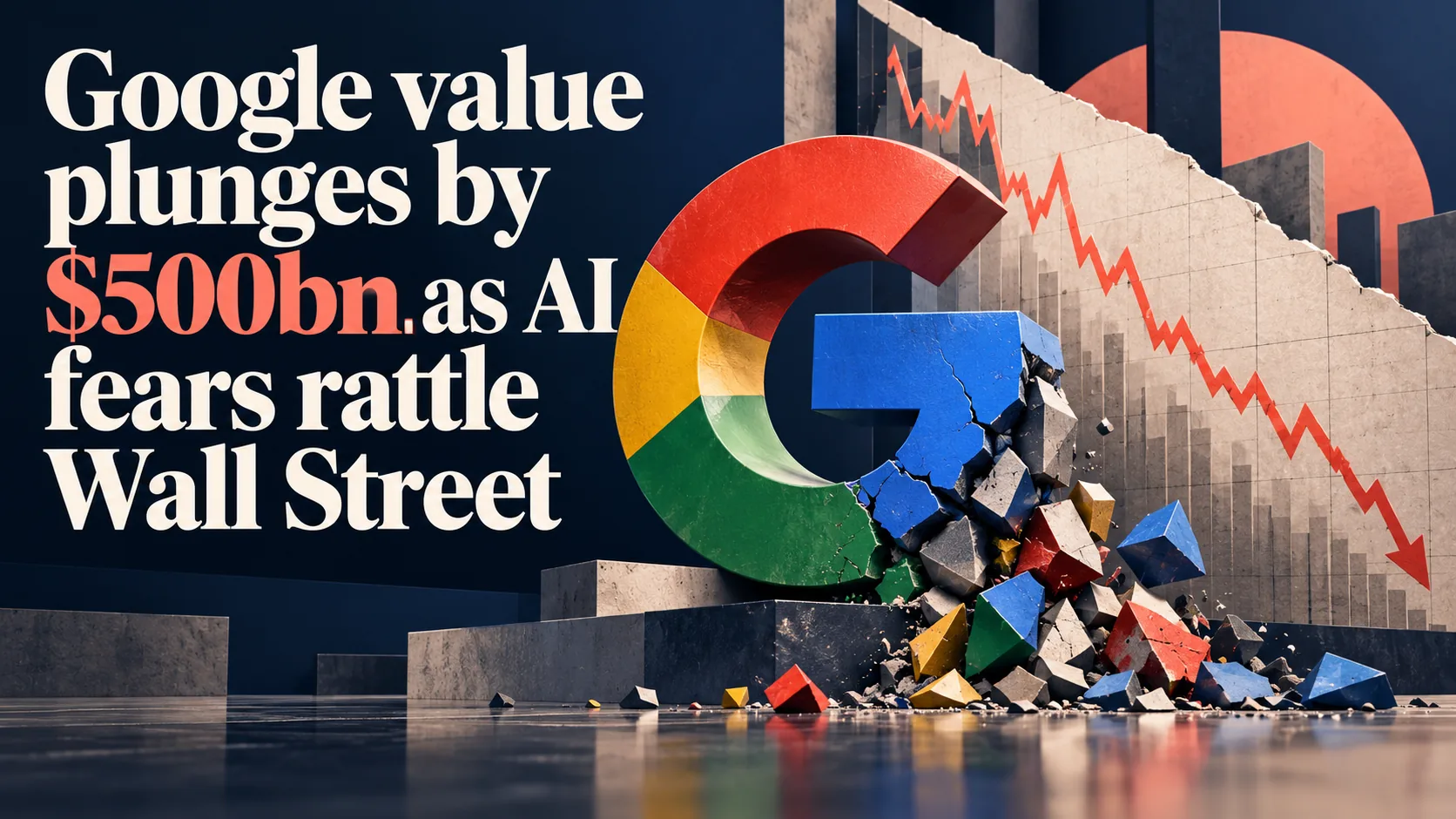
- Alphabet's market value fell from $3.97 trillion to $3.46 trillion on Thursday 29 October 2026, with shares down more than 12%.
- Quarterly revenue rose 25% year on year to $127.6bn, but earnings fell short of analyst forecasts, particularly in advertising.
- Chief business officer Philipp Schindler acknowledged that AI mode is reducing income from ads shown beside conventional answers.
- Microsoft and Amazon reported similar patterns of heavy AI spending against uneven returns.
Google’s AI-generated search summaries now answer many queries instead of showing a list of links. Alphabet has confirmed that the arrangement reduces advertising revenue from conventional results. In quarterly results published on Wednesday 28 October 2026, the company reported total revenue up 25% year on year to $127.6bn. Earnings fell short of forecasts in advertising. The next day more than $500bn of market value disappeared. Shares dropped over 12% to a six-month low, and capitalisation slid from $3.97 trillion to $3.46 trillion, as the BBC’s account of the sell-off records.
The consequential change is positional rather than technical. The AI answer now occupies the space where advertising sat, and the links it displaces were the inventory. Chief business officer Philipp Schindler acknowledged that AI mode is eating into income from ads shown beside conventional answers. He maintained that the direction of travel remains sound. Kim Scott, formerly head of Google’s advertising business, described the shift to the BBC as a deliberate long-term bet taken with short-term revenue as the stake.
That framing is coherent, and it describes a trade rather than a resolution. Revenue growth is real, and so is the earnings miss. Both come from the same quarter. Microsoft and Amazon reported comparable patterns of heavy AI spending against uneven returns. That makes the underlying question a sector one: whether the businesses funding model development can keep paying for it as the models displace the surfaces that fund them.
The citation chain
For education and research, the mechanism matters more than the share price. AI summaries are now routinely used by students and academic staff to answer questions that would once have sent them to a source. Where a summary is accurate and names what it drew on, that is a defensible shortcut. Where it replaces the visit, the publisher loses the traffic that pays for the work, and the reader loses the means to check the claim. Honest AI use in academic work depends on a citation chain a reader can follow. A summarisation layer that shortens that chain is a problem, whoever operates it.
What would have to hold
Three conditions would make this a transition rather than an erosion. Summaries would need to carry attribution that readers actually follow. Revenue, whether from advertising or subscriptions, would need to attach to the answer rather than the click. Independent measurement would need to show yield per query stabilising rather than drifting down. A single quarter does not establish any of them. The disclosed figures are context, not a forecast.