Elvis estate sues Anthropic over 274 songs used in AI training
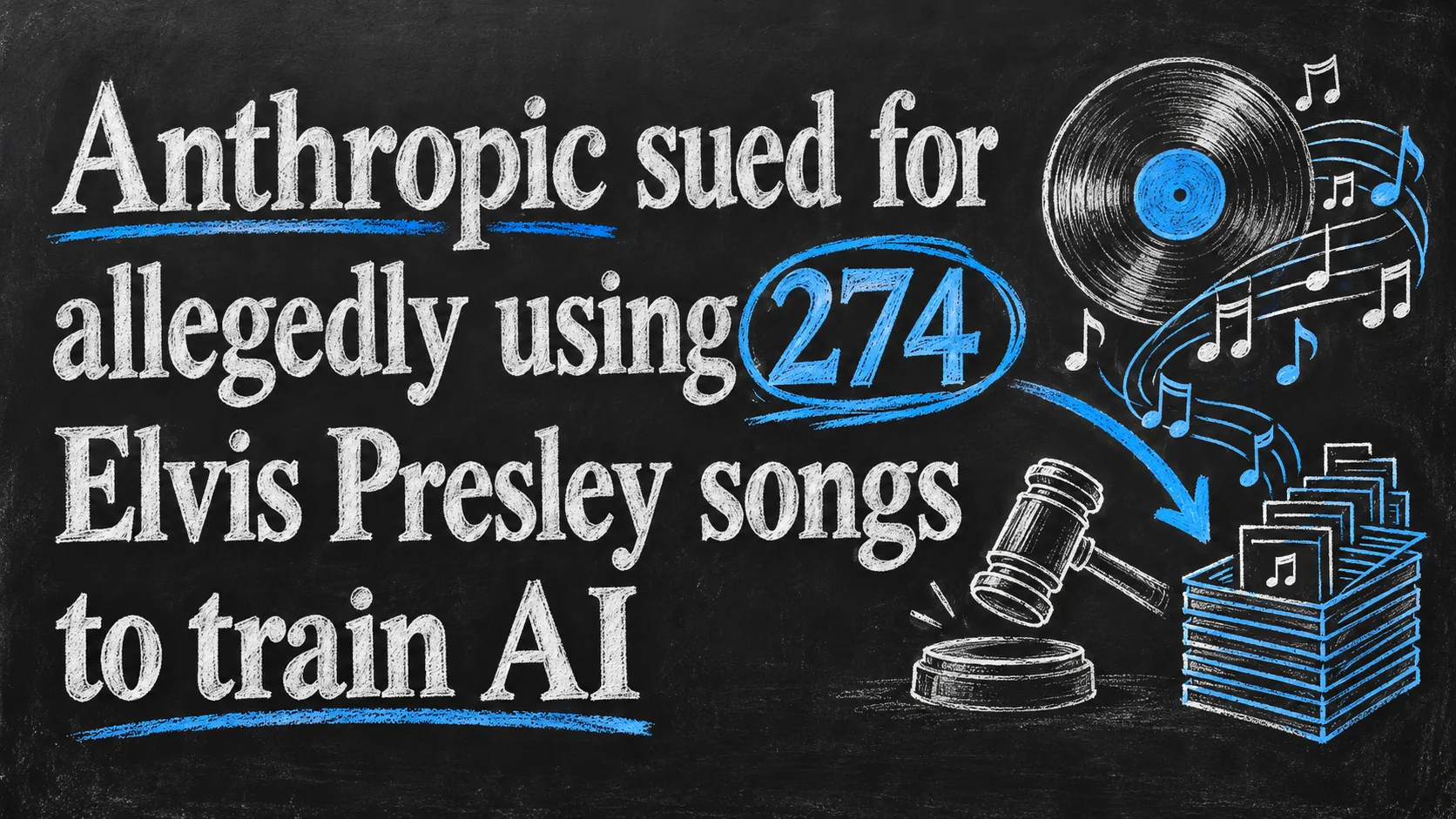
- Authentic Brands Group controls Elvis Presley's catalogue and likeness rights and has sued Anthropic over 274 Presley recordings.
- The complaint seeks $150,000 per infringed work, about $41m or £31m in total.
- The filing alleges that Claude produced output resembling copyrighted music and that guardrails were applied only after detection.
- The case is among the first major actions brought directly by an artist's estate against an AI developer.
Authentic Brands Group is the licensing business that controls Elvis Presley’s catalogue and likeness rights. It has sued Anthropic, alleging that 274 Presley recordings were used to train its models without permission. The Guardian’s report on Anthropic sued for allegedly using 274 Elvis Presley songs to train AI models’s report on the estate’s claim over Presley training data sets out the filing: tracks including Can’t Help Falling in Love, All Shook Up and A Little Less Conversation are named, and the plaintiff seeks $150,000 per work, roughly $41m or £31m in total.
The mechanics matter more than the headline figure. Those damages are statutory, claimed per infringed work rather than demonstrated as lost sales. The complaint pairs the training allegation with a second one: that Claude produced output resembling copyrighted music, and that guardrails against such output were ineffective and applied only after detection. That framing is built to support a finding of wilful infringement, which carries a higher ceiling. A complaint is a set of allegations, not a finding.
The case reaches beyond the defendant. Record companies and the RIAA have pursued AI developers before. A rights holder acting directly, though, follows a different enforcement route, with its own incentives and its own ability to litigate catalogue by catalogue. Any developer whose training corpus includes commercial music, and any platform that hosts or recommends generated audio, faces the question of how that material arrived and whether a licence can be shown to have covered it.
For education the practical lesson concerns evidence rather than alarm. Musicology teaching, audio analysis coursework and student projects built on generative tools increasingly depend on being able to say where training data came from and which licence applied. Institutions that keep procurement records, model documentation and human review logs are in a stronger position than those relying on a supplier’s assurance. The same holds for academic writing about model behaviour. Claims about a system’s outputs should be reproducible and dated.
What to watch is narrower than the damages figure. Discovery into training datasets, the court’s treatment of when the guardrails changed, and whether the dispute resolves into a licensing arrangement will matter more than the sum claimed, which is a demand rather than a judgment. Spotify’s removal of about 50 million AI-generated tracks from recommendations indicates that platforms are already adjusting their practices ahead of any ruling.