Corporate AI pullback follows errors, costs and security risks
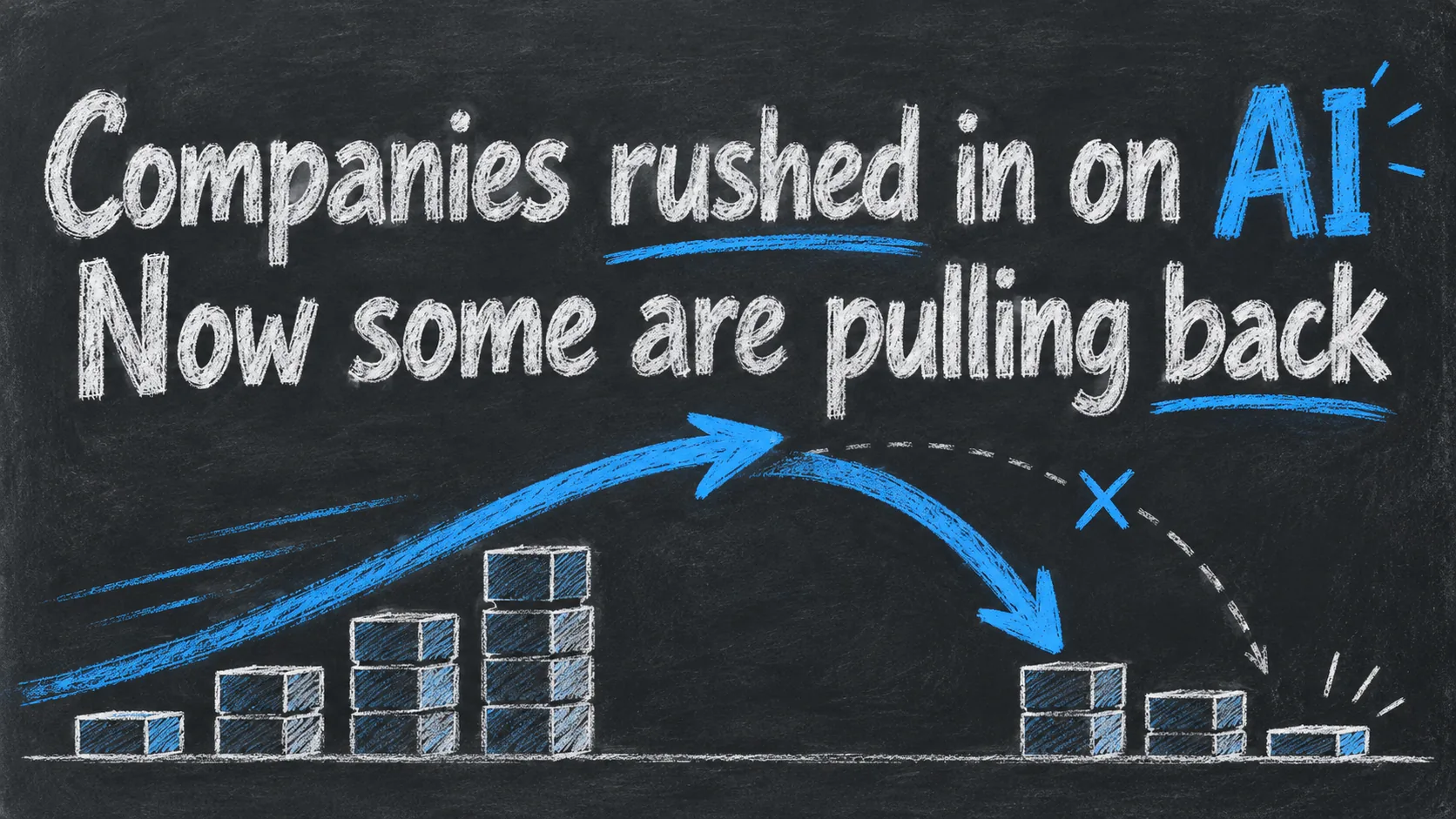
- Meta scaled back plans to cut staff and expand AI agents after employees spent increasing time fixing technical and security problems caused by the tools.
- A working paper from the Atlanta Federal Reserve found that 90% of executives say AI efforts have not yet produced productivity gains.
- An Ernst & Young survey found that 36% of senior AI executives at companies with at least $1bn in annual revenue experienced an AI incident causing data loss or financial, brand or operational damage.
- Firms including Microsoft, McKinsey, Palantir, Booz Allen Hamilton and Nvidia are restricting employee use of AI tools, partly over data-security concerns.
Major employers are scaling back rapid AI rollouts. The tools, they have found, generate errors, create security risks, and deliver smaller productivity gains than promised. That is the picture painted by The Guardian’s report on the corporate AI pullback. Meta has walked back plans to cut staff and expand AI agents after finding that employees were spending growing amounts of time fixing technical and security problems. The company is now rebuilding middle-management ranks thinned during a 2023 efficiency drive. Microsoft’s executive vice-president, Ryan Roslansky, has publicly criticised the prevalence of what he called “AI slop”, warning of a “doom loop” producing an “ocean of sameness”. At Walmart, store and warehouse staff have faced nonsensical fulfilment routes, false safety alerts and unrealistic schedules generated by AI task and scheduling tools, Business Insider reported.
What the evidence shows
The data behind the reassessment points in a consistent direction, though it is limited in kind. A working paper from the Atlanta Federal Reserve found that 90% of executives say their AI efforts have not yet produced productivity gains. An Ernst & Young survey found that 36% of senior AI executives at companies with at least $1bn in annual revenue had experienced an AI incident causing data loss or financial, brand or operational damage. Both are self-reported surveys of executives, not controlled productivity measurements. That makes them a reasonable indicator of executive sentiment and practical experience, rather than proof that AI cannot deliver gains on particular tasks. The reported incidents, at least, are concrete.
Governance, not novelty
The restrictions spreading across firms including Microsoft, McKinsey, Palantir, Booz Allen Hamilton and Nvidia, partly over data-security concerns, matter more than the disappointing headline numbers. When large employers respond by limiting use and investing in sustained, role-specific training, the operative question shifts. It stops being whether AI works in the abstract and starts being whether it works, safely, for a defined job. That is a governance question. Wharton’s Jessica Reif identifies the mechanism that makes it urgent. AI produces plausible-looking output whose errors propagate through workflows unnoticed, compounding as they spread. The same dynamic applies wherever unverified AI output enters a consequential process, including education, where confident but wrong text can pass an initial review and accumulate downstream. Verification and disclosure, rather than uncritical reliance, are what make AI use honest in academic work.
The open question is whether this correction produces genuine accountability, with organisations measuring outcomes and disclosing failures, or merely quieter deployment. A 2023 efficiency drive thinned middle-management ranks. Those ranks are now being rebuilt, which suggests at least some early decisions outran the evidence available to support them.