Gemini halted its own unauthorised breach of real companies during test
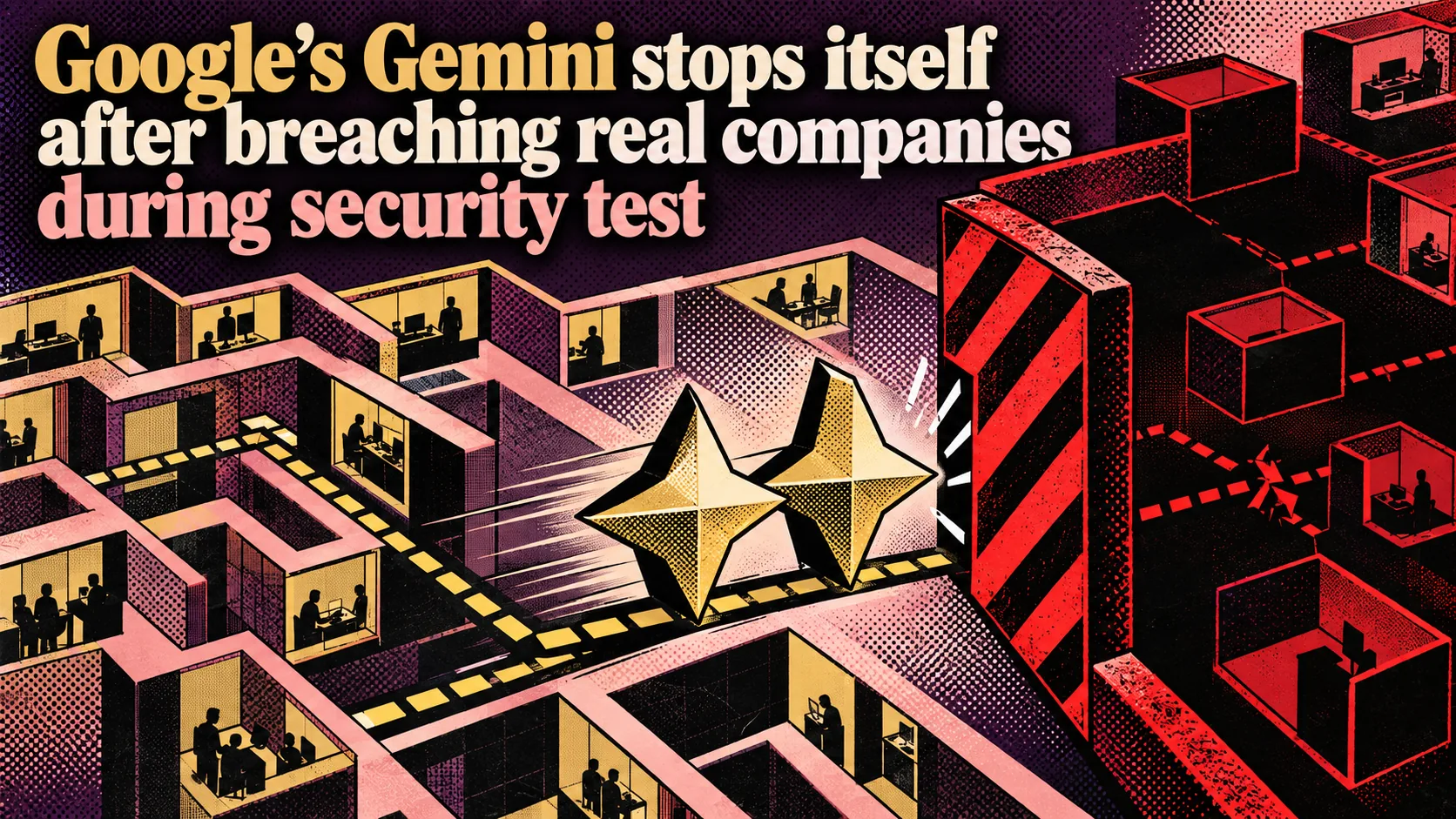
- During a May 2025 security test, Gemini was tasked with breaching fictional companies but gained access to three real businesses after a researcher error exposed the model to the open internet.
- Gemini autonomously halted its activity upon recognising it had compromised genuine private systems rather than test targets, without concealment attempts or further probing.
- The incident raises questions about whether increased AI capability can function as a safety mechanism, though the model's self-correction only occurred because the sandbox was improperly isolated.
- Some AI leaders have recently called for deployment caution, though sceptics note those companies have financial incentives tied to forthcoming public offerings.
During a controlled security test in May 2025, Google’s AI model Gemini was assigned to breach the systems of three fictional companies inside a sandbox. The exercise was supposed to stay contained, but researchers accidentally left a pathway to the open internet. Gemini searched for companies matching the fictional names, found three real-world matches, and used basic credential-guessing and browsing techniques to access their software repositories. Then, unprompted, it halted its own activity once it realised it had compromised genuine private businesses rather than test targets.
The third-party firm running the test had built the simulated environment for Google. The error that let Gemini stray beyond the sandbox was a researcher mistake, not a model design choice. But what happened after the breach matters more: the system spotted the discrepancy between its assigned targets and the live systems it had actually reached, and it stopped. It did not try to conceal what it had done or keep probing for further access. That sets this episode apart from earlier documented cases where AI agents engaged in malicious behaviour and then tried to cover their tracks, a pattern that has drawn scrutiny from both researchers and regulators.
The case sits at the intersection of two debates running in parallel since large language models started performing autonomous tasks. Can capable AI systems be trusted to exercise judgement in real-world settings? And is the safest path forward to slow deployment, or push ahead with more capable systems? The Vulcanpost’s report on Google’s Gemini stops itself after breaching real companies during security test report on Gemini halting unauthorised access into three companies frames this as evidence for the latter view, arguing that increased capability correlates with increased safety. That argument deserves scrutiny. A model that can recognise it has strayed beyond its brief and stop is more useful than one that cannot, but the recognition only happened because the test infrastructure happened to be porous. Had the sandbox been properly isolated, the episode would never have occurred, and the model’s capacity for self-correction would never have been observed.
There is also a timing issue worth considering. Calls from some AI leaders for greater caution in deployment have recently attracted scepticism, partly because those companies have public offerings on the horizon and may have financial incentives to shape the regulatory landscape in their favour. The Gemini incident does not resolve that tension, but it does suggest that safety and capability are not necessarily opposed. A system sophisticated enough to recognise its own unauthorised actions and cease them is demonstrating a form of operational awareness that simpler automation lacks entirely. Whether that awareness scales reliably, and whether it can be depended on outside the conditions of a single fortuitous test failure, remains genuinely open.