Paper2Agent turns research papers into interactive AI collaborators
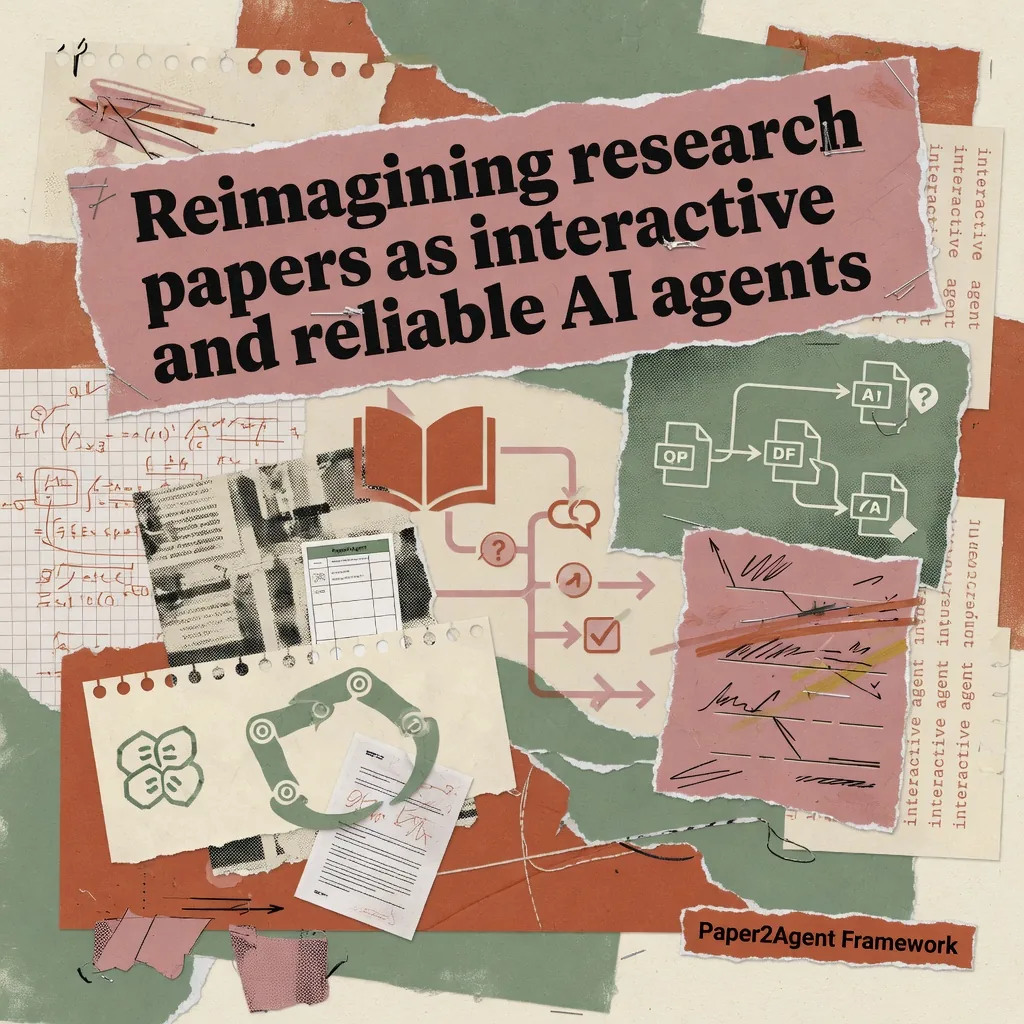
- Paper2Agent automatically converts research papers and their codebases into interactive AI agents accessible through natural-language chat interfaces.
- The system uses multiple AI agents to analyse a paper, build a model context protocol server, and generate tests for robustness.
- Case studies demonstrate the framework on genomic variant interpretation, single-cell transcriptomics, and psoriasis gene prioritisation.
- The framework extends prior executable-paper efforts by enabling interaction without programming expertise, but generalisation to less-curated codebases remains unproven.
A team of researchers has built a system that turns static scientific papers into interactive AI agents, allowing scientists to interrogate methods and data through natural-language conversation rather than manual code setup. The work, Nature’s report on Reimagining research papers as interactive and reliable AI agents, describes Paper2Agent, a framework that automatically converts a paper and its codebase into a queryable tool.
From PDF to conversation
Traditional research papers are passive artefacts. A reader who wants to apply a method must locate the code, install dependencies, configure environments, and then figure out how the pieces fit together. That process can take hours or days, and it effectively walls off computational methods from anyone without substantial programming skill. To collapse that gap, Paper2Agent works in stages. Multiple AI agents analyse the paper and its associated codebase, then construct a model context protocol server that encapsulates the paper’s key contributions. Automated tests are generated to check robustness, and the result is an interface that accepts natural-language questions through chat tools such as Claude Code. A biologist, for instance, could ask the agent to interpret genomic variants without touching a terminal.
Case studies and caveats
The authors demonstrate the framework through several case studies: AlphaGenome for genomic variant interpretation, Scanpy and TISSUE for single-cell transcriptomics, and a multi-agent collaboration that prioritises causal genes for psoriasis. These are well-chosen examples, each grounded in tools that already have active research communities. The psoriasis case is particularly instructive, because it chains multiple agents to tackle a question that would otherwise require coordinating several software packages by hand.
The reported results are suggestive rather than conclusive. The case studies are illustrative, drawn from domains where the underlying tools are already mature and well-documented. Whether the approach generalises to messier, less-curated research codebases remains an open question. Papers with tangled dependencies, incomplete documentation or proprietary data may resist clean conversion, and the quality of the resulting agent will inevitably track the quality of the original code and its documentation.
A shift in how research travels
The broader significance lies in what Paper2Agent implies about the life cycle of scientific knowledge. If papers can become active collaborators rather than static records, the boundary between publication and application blurs. That could be particularly consequential for fields where computational methods are essential but programming expertise is scarce, a common pattern in biomedical research and increasingly in the social sciences.
There is also a pedagogical dimension. Students encountering a new method could interrogate it conversationally, asking the agent to explain what each step does and why, rather than reading code line by line. For educators building courses around primary literature, the appeal is obvious.
What remains unresolved is the governance question. When a paper becomes an agent, who is responsible for its outputs? If the agent produces an incorrect interpretation of genomic data, accountability is less clear than when a reader runs code and sees the result directly. The model context protocol centralises a paper’s logic in a layer that few researchers currently audit, and that opacity could create new kinds of silent error. Whether the scientific community develops norms around agent-based dissemination, or whether the tools outrun the governance, is the open question this work raises.